Square Face Hairstyle Women Guide to Finding Your Best Look
Square Face Hairstyle Women Guide
Your face shape is the single most useful piece of information you can bring to a stylist — and most people have never actually measured it. Whether you've got a strong jawline, soft cheeks, or balanced proportions, the right haircut can completely change how your face reads in a room. This guide focuses on square face hairstyle women tend to love, but it also covers round, oval, and in-between shapes so you can figure out exactly where you fall and what to ask for.
How Face Shape Affects the Way a Haircut Looks on You
Not every haircut is universal. A blunt bob that looks incredible on one woman can make another look shorter, wider, or harder than she wants to. That's not about beauty — it's about geometry.
The basic principle is contrast. A good haircut balances your natural proportions. If your face is wide at the jawline, you want length and softness that draw the eye upward. If your face is narrow, you might want volume at the sides. Hairstylists use this logic constantly, even when they don't spell it out.
Key features that define a square face shape
A square face has roughly equal width at the forehead, cheekbones, and jaw — but the jaw is angular rather than rounded. The forehead tends to be straight across, and the chin is flat rather than pointed. Think strong. Defined. Structured.
That structure is actually a huge asset. But it does mean certain haircuts — especially those that emphasize horizontal width at the jaw — can make the face look more boxy than intended.
Author: Vivienne Ashmore;
Source: juneoils.com
How to measure your face shape at home
You don't need a professional for this. Grab a soft measuring tape or even a piece of string and measure four distances: forehead width (hairline to hairline across the widest point), cheekbone width (across the widest point of your cheeks), jawline width (from jaw corner to jaw corner), and face length (hairline to chin).
For a square face, all four measurements are close to equal, and the jaw angle is sharp. If your face length is noticeably longer than the width, you're likely oval. If your forehead is narrower than your cheeks and jaw, you might be heart-shaped. The numbers don't lie.
How to Pick a Haircut for Your Face Shape
Knowing your face shape is step one. Translating that into an actual haircut decision is where most people get stuck. Here's a practical way to think about it.
Start with your jaw. That's usually the feature that drives the most styling decisions. Then consider your forehead width and your overall face length. The goal isn't to "fix" anything — it's to create balance. A face that reads as more oval tends to look proportionate because the oval shape is close to symmetrical in length and width.
If you have a square face, you're working with a strong horizontal jawline. You want to soften that with diagonal lines, layers, and length. If you have a round face, you want to add height and reduce width. Oval faces have the most flexibility — almost any cut works, which is both a blessing and a mild curse because the options feel endless.
The pattern I see most often is that women with square faces avoid long straight hair because they think it looks harsh. But that's not always true — it depends entirely on where the weight of the hair falls. More on that below.
Questions to ask your stylist before booking
Don't walk in and say "I want something different." Be specific. Ask your stylist: "What length do you think best balances my jawline?" and "Would soft layers or face-framing pieces work for my face shape?" You can also bring photos — not to copy a look exactly, but to show the general direction you want.
A good stylist will ask about your maintenance routine too. A layered style that softens a square face can look great in the salon and fall flat at home if it requires 20 minutes of blowdrying you're not going to do.
Hairstyles for Square Face Shape That Soften Angular Jawlines
The goal with hairstyles for square face shape is to redirect attention. You want to draw the eye vertically — toward height and length — rather than across the widest point of the jaw.
Soft layers around the jawline are the single most effective tool for balancing a square face shape — they redirect the eye vertically rather than horizontally.
— Gibson Ted
That principle applies across almost every length. Whether you're going short, medium, or long, the key is avoiding blunt horizontal lines at the jaw and instead using softness, movement, and angle.
Short and medium cuts that work well
Pixie cuts with height at the crown work beautifully for square faces. The volume on top lengthens the face visually while the shorter sides don't add width. A textured pixie — not a sleek, flat one — is especially good.
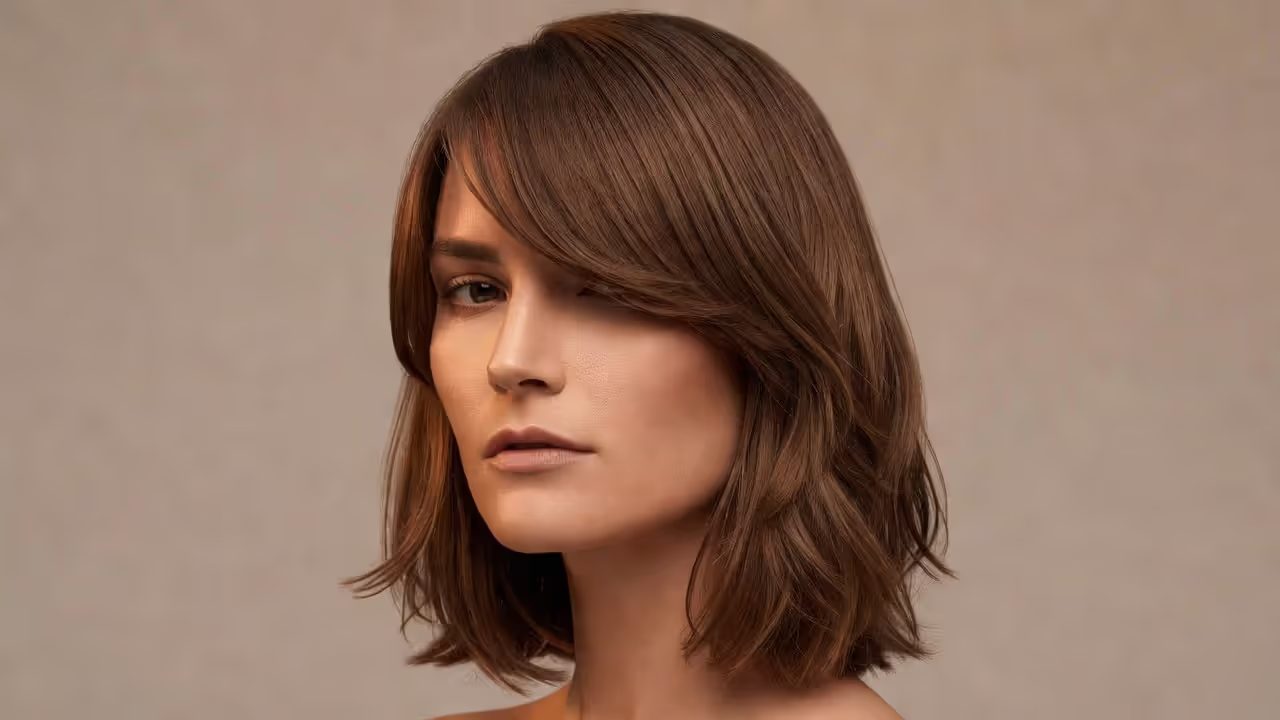
For medium lengths, the lob (long bob) hitting just below the chin is a strong choice. The key is to avoid a blunt-cut lob that ends exactly at the jaw. Instead, ask for a lob with soft layers or a slight angle — longer in front, shorter in back. That diagonal line does a lot of work.
Side-swept bangs are also a smart move. They break up the straight forehead line and add diagonal movement across the face. Blunt, straight-across bangs tend to emphasize the horizontal nature of a square face, so skip those.
Author: Vivienne Ashmore;
Source: juneoils.com
Long styles that balance strong facial structure
Long hair absolutely can work on a square face — the blunt-all-one-length version is the one to avoid. Long hair with layers, especially face-framing layers that start around the cheekbone, softens the jaw and creates movement.
Loose waves and curls are particularly effective. They add volume at the top and mid-lengths while naturally breaking up the hard line of the jaw. A long wavy style with a center part can look stunning on a square face — the waves create soft diagonals that offset the angular structure.
If you want long and straight, go for it. But ask for long layers and a slight V-shape at the ends rather than a blunt cut. That small change makes a real difference.
Round Face Layered Long Hairstyles and What Makes Them Work
A round face has roughly equal width and length, with soft curves rather than angles. The goal is usually to create the illusion of more length and less width. Long layered styles do this well — but only when they're structured correctly.
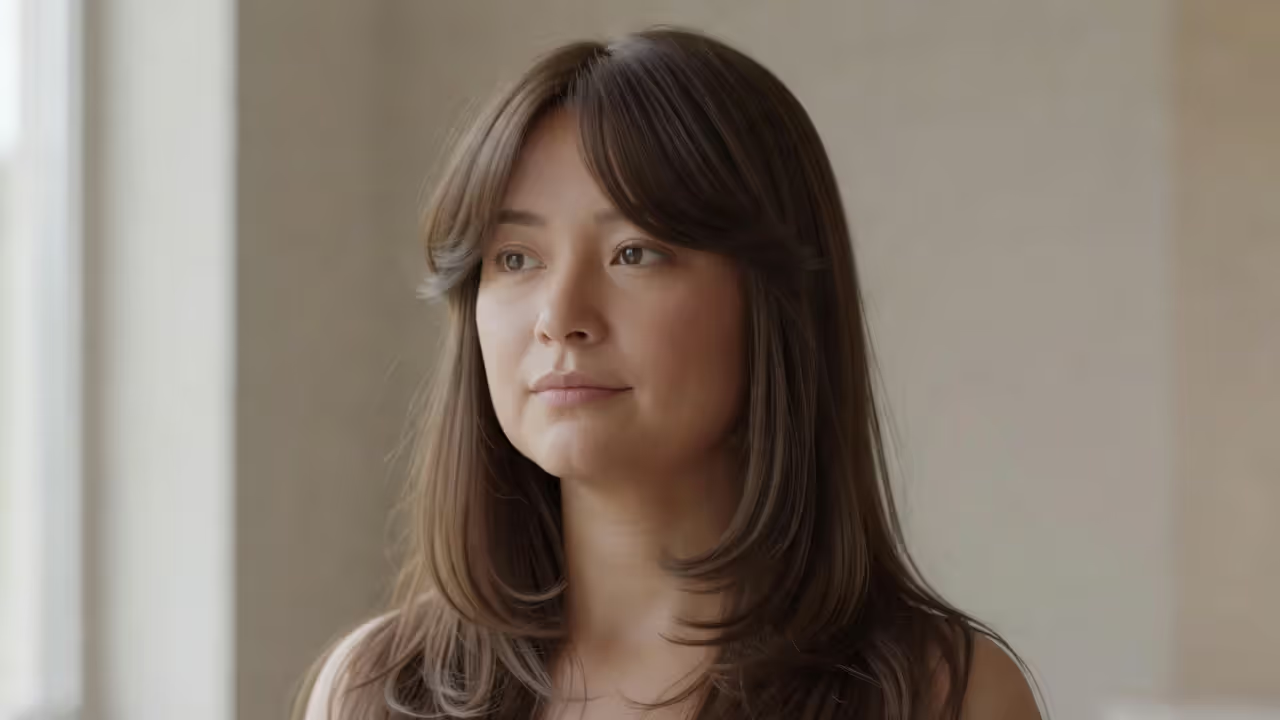
The most common mistake with round faces and long hair is adding layers that create volume at the widest point of the face (usually around the cheeks). That makes the face look wider, not longer. Round face layered long hairstyles that actually work place volume at the crown and let the length fall close to the face below the cheekbones.
Flattering layers for round faces explained by structure
Think about layers in terms of where they create fullness. For a round face, you want:
Layers starting at or above the chin that taper downward — this creates a vertical line. A long shag with curtain bangs works well because the bangs add height and the layers fall in a way that elongates. Deep side parts also help by breaking the symmetry of the round shape and adding a diagonal element.
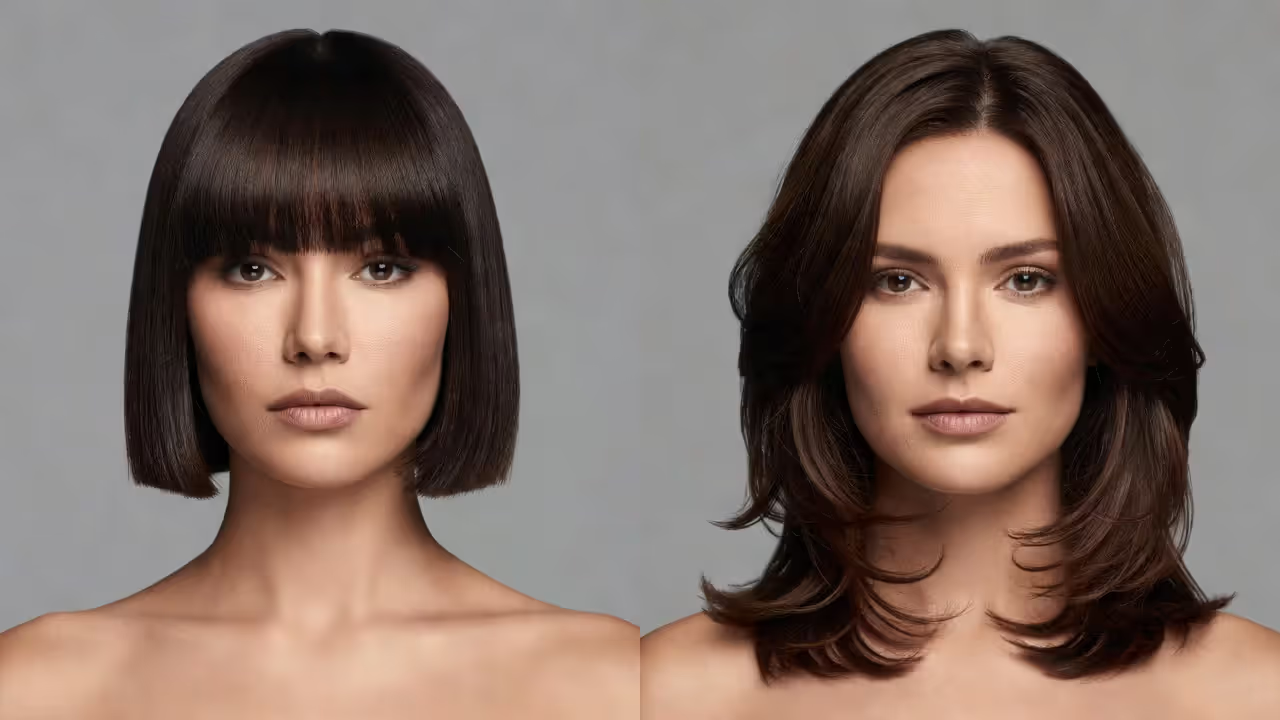
What doesn't work: blunt bobs that end at the chin, very short layers all around, and center parts with flat hair — these all emphasize the circular shape of the face rather than countering it.
Author: Vivienne Ashmore;
Source: juneoils.com
Haircuts for Oval Face Women vs. Square Face Women
Oval faces are often called the "easiest" face shape to style — and that's mostly true. The proportions are naturally balanced, so most haircuts work without needing to compensate for any dominant feature.
Square faces require more intentional styling choices. The jaw is the defining feature, and haircuts need to work around it. Oval faces don't have that constraint.
Here's a side-by-side comparison to make the differences concrete:
| Feature | Square Face | Oval Face |
| Face shape characteristics | Equal width at forehead, cheeks, jaw; angular chin | Length slightly greater than width; soft jaw; balanced proportions |
| Best haircut styles | Layered lobs, long waves, textured pixies, side-swept styles | Almost any cut; bobs, pixies, long layers, blunt cuts all work |
| Layer types | Soft face-framing layers starting at cheekbone | Any layer type; long layers, short layers, shag cuts |
| Bang styles | Side-swept, curtain bangs, arched bangs | All bang styles work; blunt bangs especially flattering |
| Styles to avoid | Blunt jaw-length bobs, straight-across bangs, very short bobs with no movement | Very few restrictions; extremely voluminous styles can overwhelm petite oval faces |
The practical takeaway: if you have an oval face and you're unsure what to get, you have real freedom. If you have a square face, focus on cuts that add vertical movement and avoid anything that emphasizes the horizontal jaw width.
Hairstyle Mistakes to Avoid Based on Your Face Shape
Getting the right cut is half the battle. Avoiding the wrong one is the other half.
For square faces, the biggest mistake is a jaw-length blunt bob. It ends exactly where the face is widest and adds no softening movement. Another common error: very short, very flat styles with no volume at the crown. These make the face look wider and shorter than it is. If you love short hair, add texture and height.
For round faces, the mistake is usually adding layers in the wrong place. Flattering layers for round faces need to create length, not width. Layers that feather out at cheek level do the opposite of what you want. And avoid chin-length cuts unless they have significant movement and angle.
For oval faces, the main pitfall is going too voluminous all over. A huge, wide style can actually make even a balanced oval face look disproportionate. Keep volume intentional — crown height is great, width at the sides less so.
One more thing that applies across all face shapes: don't choose a haircut based purely on what looks good on a celebrity or influencer without checking whether your face shape matches theirs. A style that's perfect on a heart-shaped face can be actively unflattering on a square face. Always filter inspiration through your own measurements.
Author: Vivienne Ashmore;
Source: juneoils.com
FAQ: Square Face and Face Shape Hairstyle Questions Answered
Knowing your face shape doesn't limit your options — it sharpens them. Once you understand the basic geometry of your features, every haircut decision gets easier and more confident. Whether you're working with a square jawline, round cheeks, or an oval baseline, the right cut is out there. Bring your measurements, bring a few photos, and don't be afraid to tell your stylist exactly what you're trying to balance.
Related Stories

Read more
Read more


The content on this website is provided for general informational and educational purposes only. It is intended to explain concepts related to cosmetology, hair care, skincare, aesthetic treatments, and beauty procedures.
All information on this website, including articles, guides, and examples, is presented for general educational purposes. Results may vary depending on individual skin type, hair type, or treatment protocols.
This website does not provide professional medical, dermatological, or cosmetic services, and the information presented should not be used as a substitute for consultation with licensed aestheticians, dermatologists, or medical professionals.
The website and its authors are not responsible for any errors or omissions, or for any outcomes resulting from decisions made based on the information provided on this website.