
Almond Oil Comedogenic Rating and What It Means for Your Skin
Almond Oil Comedogenic Rating

Sweet almond oil has been a staple in skin care for centuries. It's lightweight, deeply nourishing, and smells faintly nutty in the best possible way. But if you're dealing with acne-prone or oily skin, one number matters more than any of that: its comedogenic rating. That single figure can tell you a lot about whether an oil is likely to clog your pores — or play nicely with your skin.
Understanding where almond oil sits on the comedogenic scale helps you make smarter choices. And if it turns out it's not the right fit for your skin type, you'll also know exactly which oils to reach for instead.
What Does Comedogenic Mean and Why It Matters for Skin Care
The word "comedogenic" comes from "comedone" — the clinical term for a clogged pore. Comedones form when dead skin cells, sebum, and other debris block a hair follicle. When that blockage stays under the skin, it's a whitehead. When it's exposed to air and oxidizes, it becomes a blackhead.
So "comedogenic" literally means "pore-clogging." And "non-comedogenic" means a product or ingredient is unlikely to cause that blockage. The distinction matters enormously if your skin is already prone to breakouts.
Here's the thing people often miss: comedogenicity isn't binary. It's not simply "clogs pores" or "doesn't clog pores." It exists on a spectrum.
How the Comedogenic Rating Scale Works
The comedogenic rating scale runs from 0 to 5. It was developed through rabbit ear assay tests — a method where substances were applied to rabbit ears and observed for follicular changes. The scale has limitations (more on that shortly), but it's still the most widely referenced framework in skin care.
Here's what the numbers mean in plain terms:
- 0 — Won't clog pores at all
- 1 — Very low likelihood of clogging
- 2 — Moderately low; generally safe for most skin types
- 3 — Moderate; may cause issues for sensitive or acne-prone skin
- 4 — High; likely to clog pores for many people
- 5 — Very high; almost certain to cause congestion
What Rating Levels Indicate for Different Skin Types
Dry skin types can usually tolerate ratings up to 3 or even 4 without problems. The skin is less reactive, and the extra occlusion can actually help lock in moisture. Oily and acne-prone skin is a different story. Anything rated 3 or above carries real risk of triggering breakouts. Combination skin tends to fall somewhere in between — it depends heavily on where you're applying the oil.
One important caveat: the scale was built on lab conditions, not real human skin. Individual responses vary. A lot.
Author: Vivienne Ashmore;
Source: juneoils.com
Where Almond Oil Falls on the Comedogenic Scale
Sweet almond oil has a comedogenic rating of 2. That puts it in the "moderately low" category — generally considered safe for most skin types, but not entirely without risk for people who break out easily.
The rating of 2 means it has a low-to-moderate chance of clogging pores. It's not the cleanest option on the scale, but it's far from the most problematic. Coconut oil, for comparison, clocks in at a 4. Almond oil is nowhere near that territory.
What makes almond oil sit at a 2? Its fatty acid profile is the main driver. It's rich in oleic acid (omega-9), which makes up roughly 60–70% of its composition. Oleic acid is deeply moisturizing and penetrates well into the skin — but it's also the fatty acid most associated with pore congestion in acne-prone individuals. The higher the oleic acid content, the higher the comedogenic rating tends to be.
Almond oil also contains linoleic acid (omega-6), which is actually beneficial for acne-prone skin. Linoleic acid helps keep the skin barrier intact and has anti-inflammatory properties. But oleic acid is dominant in almond oil, which nudges its rating upward.
A common mistake people make is assuming a rating of 2 is automatically safe for their acne-prone skin. It's not a guarantee. It's a guideline.
How Almond Oil Behaves on Acne-Prone Skin
This is where things get nuanced. A rating of 2 doesn't mean almond oil will break you out. But it does mean you should approach it with some caution if your skin is oily or reactive.
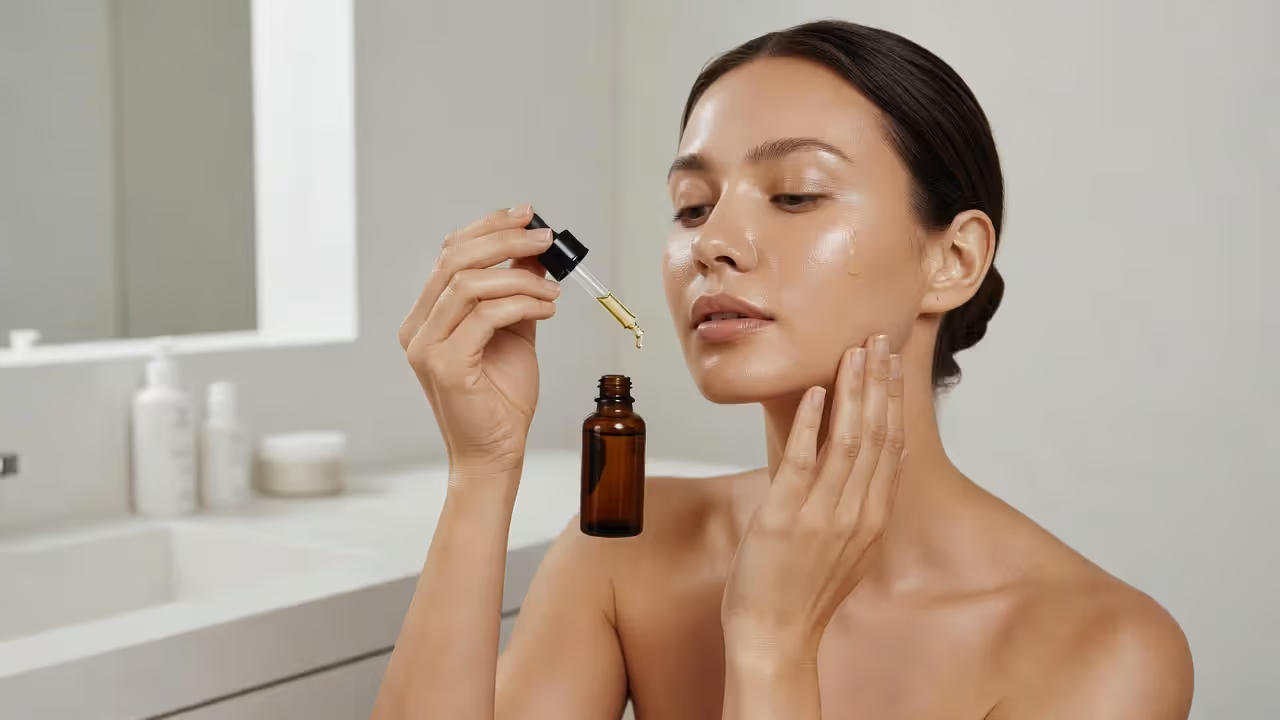
For dry or normal skin types, almond oil is typically a great choice. It absorbs reasonably well, doesn't leave a heavy residue, and delivers real moisture. For combination skin, it often works fine on drier areas like the cheeks but can be too rich for the T-zone.
For oily and acne-prone skin? This varies the most. Some people with oily skin use almond oil without any issues. Others notice congestion within a week or two of daily use. The pattern I see most often is that people with oily skin who are also prone to closed comedones (those small bumps under the skin) react more negatively to oleic-heavy oils like almond.
Sensitive skin without a tendency toward breakouts usually handles almond oil well. It's gentle, non-irritating, and doesn't contain fragrance in its pure form.
Author: Vivienne Ashmore;
Source: juneoils.com
One real-world scenario worth considering: if you're using almond oil as a carrier oil in a DIY face blend, the overall comedogenic rating of your mix will depend on every ingredient in it. Adding almond oil to a formula that already contains other moderate-rating oils can push the combined effect higher.
Almond Oil vs. Other Face Oils — A Side-by-Side Comparison
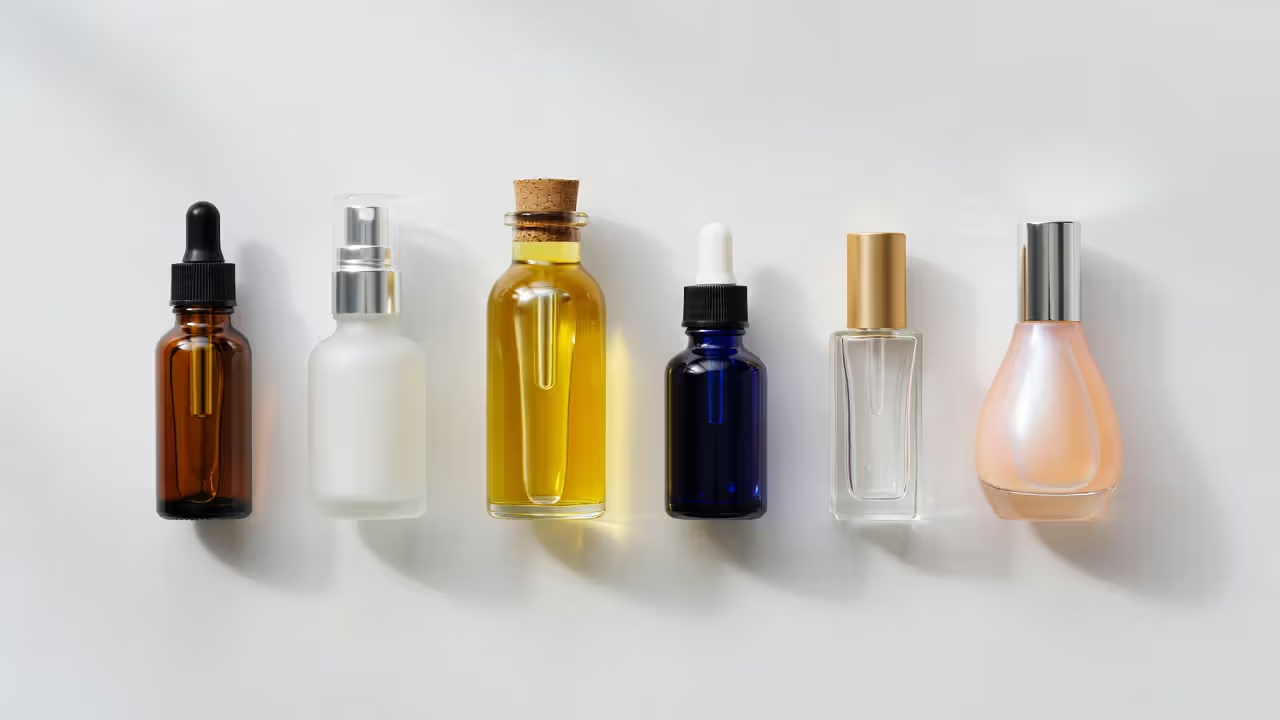
Here's how almond oil stacks up against five other popular face oils. The comedogenic ratings below are the most consistently cited values across dermatology and cosmetic chemistry sources.
| Oil | Comedogenic Rating (0–5) | Skin Type Suitability | Key Fatty Acids | Recommended for Acne-Prone Skin |
| Sweet Almond Oil | 2 | Dry, Normal, Combination | Oleic (60–70%), Linoleic (20–30%) | With caution |
| Jojoba Oil | 2 | All skin types | Wax esters (not true fatty acids) | Yes |
| Rosehip Oil | 1 | All skin types, esp. sensitive | Linoleic (35–45%), Linolenic (30–35%) | Yes |
| Argan Oil | 0–1 | All skin types | Oleic (43–49%), Linoleic (29–36%) | Yes |
| Coconut Oil | 4 | Dry, Normal | Lauric acid (45–50%) | No |
| Marula Oil | 3–4 | Dry, Mature | Oleic (70–78%) | No |
Author: Vivienne Ashmore;
Source: juneoils.com
Is Jojoba Oil a Better Option for Acne-Prone Skin
Technically, jojoba oil shares the same comedogenic rating as almond oil — both sit at 2. But in practice, jojoba behaves very differently. That's because jojoba isn't actually an oil in the traditional sense. It's a liquid wax ester, which means it mimics the structure of the skin's own sebum more closely than any other plant-derived oil.
Because of this, jojoba is often better tolerated by oily and acne-prone skin. It can actually help regulate sebum production rather than adding to it. Many dermatologists consider it one of the safest face oils for breakout-prone skin, despite the shared rating of 2.
So yes — for acne-prone skin specifically, jojoba is generally the better option between the two.
Which Non-Comedogenic Oils Work Best for Sensitive or Breakout-Prone Skin
If you want to minimize risk, stick to oils rated 0 or 1. Here are the top performers:
Rosehip oil is one of the best choices. Rated at 1, it's high in linoleic acid and trans-retinoic acid (a natural form of vitamin A), which means it can actually help reduce the appearance of acne scars and hyperpigmentation over time.
Argan oil is rated 0–1 and works beautifully on almost every skin type. It's balancing, absorbs quickly, and has a strong antioxidant profile thanks to vitamin E content.
Hemp seed oil is rated 0 and is one of the few oils with an almost perfectly balanced ratio of linoleic to oleic acid. That balance makes it especially well-suited for acne-prone skin.
Squalane (derived from olives or sugarcane) is rated 0–1 and is often recommended by dermatologists for sensitive skin. It's incredibly stable, doesn't oxidize easily, and feels light on the skin.
The simpler option usually wins here. If your skin breaks out easily, start with a single-ingredient oil rated 0 or 1 before experimenting with blends.

Author: Vivienne Ashmore;
Source: juneoils.com
How to Patch Test a Face Oil Before Adding It to Your Routine
No matter what the comedogenic rating says, a patch test is your best insurance policy. Here's how to do it properly.
Choose a small area — the inner arm or the side of your jaw are both good options. Apply a small amount of the oil to clean, dry skin. Leave it on for 24 hours without washing it off. Check for redness, itching, or small bumps. If nothing happens, repeat for two more days before applying it to your full face.
Don't rush this. Some reactions take 48–72 hours to show up, especially if the issue is pore congestion rather than irritation.
A few things to keep in mind: don't patch test during a flare-up. Your skin is already reactive, and results won't be accurate. And don't test more than one new product at a time — you won't know which one caused a reaction if you do.
If you're testing almond oil specifically, apply it to a small area of your face (not just your arm) for the most relevant result. The skin on your face has more sebaceous glands and behaves differently than skin elsewhere on your body.
Comedogenic ratings give us a useful starting point, but they were developed in lab settings that don't always reflect how real skin responds. I always tell patients that individual factors — your skin's baseline oil production, the other products you're using, and even your diet — can influence whether a given ingredient causes breakouts for you specifically.
— Zeichner Joshua
FAQ: Almond Oil Comedogenic Rating Questions Answered
The almond oil comedogenic rating of 2 makes it a reasonable choice for many skin types — but not a universal one. If your skin is dry or normal, you'll likely do just fine with it. If you're oily or acne-prone, it's worth testing carefully or swapping to a lower-rated alternative like rosehip or argan oil. The rating is a starting point, not a verdict. Your skin's actual response is always the final word.
Related Stories
Read more
Read more


The content on this website is provided for general informational and educational purposes only. It is intended to explain concepts related to cosmetology, hair care, skincare, aesthetic treatments, and beauty procedures.
All information on this website, including articles, guides, and examples, is presented for general educational purposes. Results may vary depending on individual skin type, hair type, or treatment protocols.
This website does not provide professional medical, dermatological, or cosmetic services, and the information presented should not be used as a substitute for consultation with licensed aestheticians, dermatologists, or medical professionals.
The website and its authors are not responsible for any errors or omissions, or for any outcomes resulting from decisions made based on the information provided on this website.