

Is a Dorsal Hump Nose Attractive or Worth Changing
Is a Dorsal Hump Nose Attractive or Worth Changing?

Content
Content
A dorsal hump nose is one of the most common and recognizable nose profiles in the world. That curved or angled ridge along the bridge — made of bone, cartilage, or both — shows up across dozens of ethnic backgrounds and has been celebrated, scrutinized, and misunderstood for centuries. If you have one, you've probably wondered at some point whether it's something to embrace or something to change. The answer isn't as simple as either option.
What Is a Dorsal Hump and Why Do People Have One
A dorsal hump is a raised area along the nasal bridge. It's not a deformity. It's an anatomical variation — a natural result of how bone and cartilage develop along the nose's dorsum (the top surface running from the forehead to the tip). The hump itself is typically a combination of the nasal bones and the upper lateral cartilages. In some people, the bone dominates; in others, it's mostly cartilage. That distinction matters a lot if you're ever considering reshaping options.
Genetics drive most cases. If your parents or grandparents had prominent nasal bridges, there's a solid chance you inherited the same structure. Certain ethnic groups — people of Mediterranean, Middle Eastern, South Asian, and Eastern European descent — show higher rates of dorsal humps simply because of inherited facial bone structure. That's not a flaw in the blueprint. It's just how the blueprint reads.
Injury is another cause. A broken nose that heals without correction can create or worsen a hump. And some people develop a more noticeable hump through no single event at all — it just becomes more defined as facial bones mature through the late teens and early twenties.
How a Dorsal Hump Forms Over Time
The nose doesn't fully stop developing until around age 17 to 18 in women and slightly later in men. During adolescence, the nasal bones and cartilage go through growth spurts that can make a mild hump look more pronounced. A hump that seemed minor at 14 might be clearly defined by 20.
Trauma plays its own role. Even minor impacts — a sports collision, a fall — can shift nasal bones slightly. If those shifts aren't corrected quickly, they can set into a new position that creates or amplifies a hump.
And yes, aging matters too. As skin thins and soft tissue volume decreases with age, the underlying bone and cartilage structure becomes more visible. A hump that was subtle at 30 might look more prominent at 55 — not because the bone grew, but because the padding around it reduced.
Nose Shapes Explained — Where the Dorsal Hump Fits
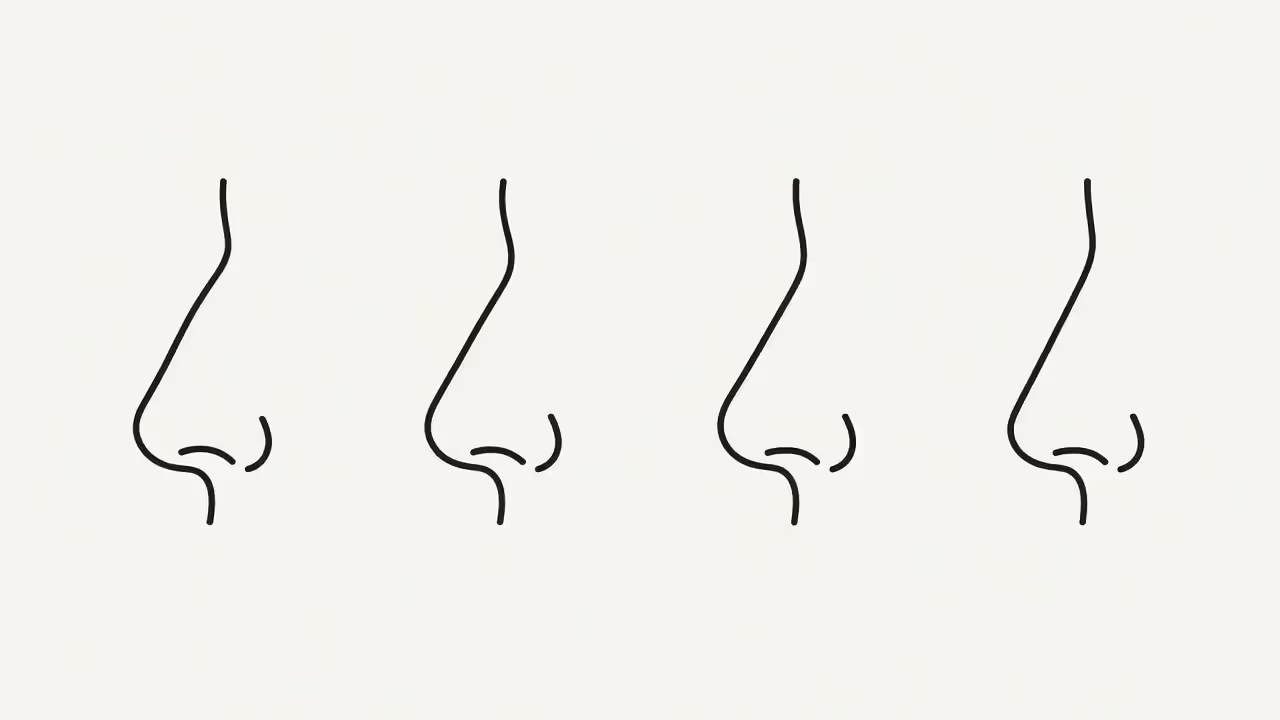
Nose shapes exist on a wide spectrum. Researchers and facial surgeons have identified anywhere from 14 to over 30 distinct nose types depending on how granular the classification gets. For most people, though, a handful of categories cover the range: the straight bridge, the concave or upturned nose, the bulbous tip, the wide base, and the dorsal hump profile.
The dorsal hump nose sits in the convex category. Viewed from the side, the bridge curves outward rather than running in a straight or inward line. This is what separates it visually from a straight Roman nose or the upturned profile of a turned up nose.
Author: Colton Everly;
Source: juneoils.com
A turned up nose — sometimes called a celestial nose — points slightly upward at the tip, creating a concave bridge line. It's the near-opposite profile of a dorsal hump. Both are natural variations. Neither is objectively better. But they're often placed at opposite ends of the aesthetic conversation, which is worth understanding if you're trying to make sense of your own features.
The dorsal hump nose attractive debate often comes down to context — face shape, skin tone, eye spacing, and cultural background all influence how a prominent bridge reads on any given person.
The Castilian Nose vs. the Turned Up Nose — A Direct Comparison
The Castilian nose is a specific type that gets discussed a lot in facial aesthetics. It's long, narrow, and straight — with a slightly prominent bridge that doesn't curve dramatically but does have presence. It's named after the Castile region of Spain and is associated with traditional Iberian facial features. Think of it as a refined, aristocratic profile: strong but not dramatic.
The turned up nose sits at the other end of the visual spectrum. It's shorter, with a tip that rotates upward — giving the face a softer, more youthful appearance in profile. It's often seen as "cute" or "perky" in Western beauty contexts, though that perception doesn't hold universally.
A dorsal hump nose falls between and beyond both. It has more visible bridge structure than the Castilian and projects outward rather than upward like the turned up type.
| Nose Type | Profile Shape | Common Ethnic/Geographic Association | General Public Perception | Reshaping Frequency |
| Castilian | Long, narrow, straight bridge | Spanish, Iberian, Southern European | Elegant, aristocratic | Moderate |
| Turned Up (Celestial) | Short, concave bridge, upturned tip | Northern European, East Asian | Youthful, soft, "cute" | Low to moderate |
| Dorsal Hump | Convex bridge, visible ridge | Mediterranean, Middle Eastern, South Asian, Eastern European | Striking, strong, sometimes "ethnic" | High |
| Button/Snub | Small, round, slightly upturned | Varied, common in East Asian features | Delicate, petite | Low |
The pattern I see most often is that people with dorsal humps seek reshaping at higher rates than those with Castilian or button noses — not because the hump is less attractive, but because Western beauty media has historically underrepresented it as a positive feature.

Author: Colton Everly;
Source: juneoils.com
Cultural Beauty Standards and the Dorsal Hump Nose
Beauty standards aren't fixed. They shift with media, migration, and generational values — and the dorsal hump nose is a clear example of that shift in action.
In ancient Greece and Rome, a strong, prominent nasal bridge was a marker of nobility and power. Coins and sculptures from that era show idealized figures with defined, slightly convex profiles. The hump wasn't hidden — it was carved in marble.
In Mediterranean, Middle Eastern, and South Asian cultures, a prominent bridge has long been seen as a sign of character and heritage. In Iran, nose jobs are performed at extremely high rates — but that's partly a function of social signaling, not a universal rejection of the dorsal hump. In Italy and Greece, attitudes are more mixed, with many people viewing their natural profiles as part of their identity.
The shift happening in the US right now — particularly among younger generations — is a move toward embracing ethnic features rather than erasing them. Celebrities and influencers with prominent bridges are increasingly celebrated rather than advised to "fix" their noses. That's a meaningful change from even a decade ago.
We're seeing a real shift in what patients bring into consultations. More people are coming in to enhance their natural features rather than erase them. A dorsal hump that might have been the first thing someone wanted removed ten years ago is now something many patients want to preserve — or even make more defined. Natural is having a moment, and I think it's here to stay.
— Cochran William
Non Surgical Nose Reshaping Options for a Dorsal Hump
Not everyone with a dorsal hump wants surgery — and not everyone needs it. There are real, effective non-surgical options worth knowing about before you book a rhinoplasty consultation.

Author: Colton Everly;
Source: juneoils.com
Filler rhinoplasty (also called a liquid nose job) is the most popular non-surgical route. A provider injects hyaluronic acid filler above and below the hump to create the illusion of a straighter bridge. It doesn't remove the hump — it camouflages it by leveling the surrounding areas. Results are visible immediately and can look genuinely impressive when done well.
Makeup contouring is a zero-commitment option. A thin line of matte contour powder along the sides of the bridge can visually narrow and straighten it. It's temporary, obviously, but it's a useful tool for people who want to experiment before committing to anything.
Nose tape or strips are used by some people to temporarily compress or reshape the appearance of the bridge for photos or short-term wear. Results are minimal and not suitable for daily use.
The best candidates for non-surgical reshaping are people with mild to moderate humps who want subtle correction without downtime. If your hump is large or if you also want to change the tip shape significantly, fillers will have real limitations.
One common mistake: assuming filler can make a nose look smaller. It can't — adding volume to straighten a profile technically adds size. The visual illusion works, but the nose isn't physically reduced.
How Long Non Surgical Results Typically Last
Hyaluronic acid fillers in the nose typically last 9 to 12 months, though some patients see results for up to 18 months depending on the product used and individual metabolism. Touch-up appointments are usually needed once a year to maintain the look.
Cost in the US ranges from roughly $600 to $1,500 per session depending on the provider's experience, location, and the amount of filler used. Board-certified plastic surgeons and dermatologists tend to charge more than medical spas — but for nose filler specifically, provider skill matters enormously. The nose is a high-risk area for filler complications, so this isn't a place to cut costs.
When to Consider Surgical Rhinoplasty Instead
Non-surgical options have a ceiling. If your dorsal hump is large, if you want permanent results, or if you have breathing issues connected to your nasal structure, surgical rhinoplasty is the more appropriate path.
Functional concerns are a separate category entirely. Some people with dorsal humps also have a deviated septum or internal valve collapse that restricts airflow. In those cases, surgery isn't just cosmetic — it's corrective. Insurance may cover the functional portion of the procedure.
Surgical reduction of a dorsal hump involves shaving or rasping the bone and cartilage to lower the bridge profile. It's one of the most commonly performed rhinoplasty techniques and, when done by an experienced surgeon, produces natural-looking, permanent results. Recovery typically involves 1 to 2 weeks of visible swelling and bruising, with full results settling over 12 months as residual swelling resolves.
Surgery is a significant commitment. But for people who've lived with a hump they genuinely dislike for years — and who've already tried non-surgical options — it's often the right call.

Author: Colton Everly;
Source: juneoils.com
FAQ: Dorsal Hump Nose Questions Answered
Your nose is one of the most defining features of your face — and a dorsal hump is one of the most human variations it can have. Whether you choose to embrace it, soften it with filler, or pursue surgery, the decision should come from your own values and preferences — not from outdated beauty standards that were never built with your features in mind. Know your options, talk to qualified providers, and don't let anyone tell you a strong bridge isn't worth keeping.
Related Stories

Read more
Read more

The content on this website is provided for general informational and educational purposes only. It is intended to explain concepts related to cosmetology, hair care, skincare, aesthetic treatments, and beauty procedures.
All information on this website, including articles, guides, and examples, is presented for general educational purposes. Results may vary depending on individual skin type, hair type, or treatment protocols.
This website does not provide professional medical, dermatological, or cosmetic services, and the information presented should not be used as a substitute for consultation with licensed aestheticians, dermatologists, or medical professionals.
The website and its authors are not responsible for any errors or omissions, or for any outcomes resulting from decisions made based on the information provided on this website.